
Opening the Toy Chest: Mathematical drawing tool became Spirograph®
The elegance of mathematics wasn’t a passing thought when I was a youngster. A drawing set introduced the graceful orderliness without my even knowing it. Securing the larger ring with cut-out centre on paper with small red-domed tacks, I poked my pen tip through one of the many small holes on the small plastic wheel, and then rotated the gear-shaped disc. The teeth of both ring and wheel meshed as I guided the disc round and round, creating beautiful artwork. Introduced in 1965, the magic of Spirograph® is built right into the wheel design, based on principles conceived hundreds of years ago.
An English civil engineer, Joseph Jopling used a septenary system (a base-7 number system) to design curved line techniques in the 1820s. He was sure that the navy could use the scheme in ship construction. Contacting the Navy Board in 1822 to promote his system, he described drawing curved lines in continuous motion along with midship curves. He added that “the principle of generating such curves is equally applicable to the making of a small drawing, and to the describing at full size the mid-ship frame of a vessel of the greatest magnitude,” Jopling was quoted in Mechanics Magazine, Vol 8, 1828. Officials listened but did not give the response the inventor desired.
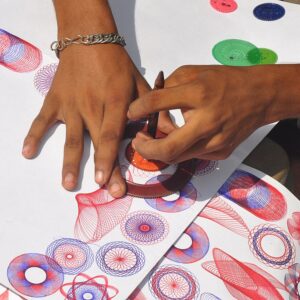
Patented by Denys Fisher in the 1960s, Spirograph(R) remains a favourite drawing toy with all ages. Wikimedia Commons 2011
In 1823, Jopling wrote The Septenary System of Generating Curves by Continued Motion: Including Sundry Observations on the System, a short book that fleshed out his ideas. Publishing information in a magazine about his apparatus, Jopling complained about the navy’s lack of interest. Navy officials rebuffed Jopling by publishing their own version in a later issue of the magazine. They disclosed that such mathematical instruments had already been shown to them thirty years earlier. “Mr. Jopling’s (in all appearances) is a facsimile.” The mathematical genius Galileo (1564-1642); James Watt, inventor of the steam engine in the 1700s; and many more gave the drawing tools a try, long before Jopling.
The idea of continuous drawing remained a fascinating idea and in about 1900, the Marvelous Wondergraph was advertised in Sears catalogues as a drafting toy. The system used a pen attached to a rod that hand-cranked a lever creating elaborate designs on paper that was attached to a rotating disc. The Marvelous Wondergraph was in production until 1930. Similar drawing toys appeared on the market, then in mid-century, along came Spirograph, capturing imaginations of artists, young and old.
A British engineer in the early 1960s grabbed the ageless idea and modernized it. Denys Fisher (1918-2002) was a skilled mathematician who left university to work at the family industrial lubricant business called Kingfisher Ltd. He developed “new methods of manufacturing efficiencies,” said Todd Coopee on Toy Tales. Leaving the family operation in 1960, Fisher established Fisher Engineering, “creating precision components for NATO amongst others.”
Part of the engineer’s work was development of pattern drawing machines. While testing designs with a Meccano set, Fisher devised components to draw complicated geometrical designs. He discussed his simple yet complex idea with family members, who encouraged him to bring the brilliant drawing set to market. In 1965, the hopeful toy-maker opened Denys Fisher Toy Group. Awarded patents overseas, Spirograph was first sold in Leeds, England.
In July 1964, Fisher filed under the Designs Instruments or Apparatus category with the United States patent office. Attaching schematics of the instruments to the comprehensive application, Fisher distilled the purpose of his request into simplified language. “The designs or patterns may be applied to paper or other surfaces by employing a pen, stylo, scraper or graver, and said instrument or apparatus may be employed for industrial or for educational purposes or for amusement.” The application then became technical, complicated, and wordy.
The invention “comprises an internally toothed ring or primary member or members and an externally toothed disc or secondary member or members which latter member or members is or are furnished with a single aperture or a plurality of apertures for accommodating a pen, pencil or like device, whereby when the teeth of the members are in mesh the pen or like device serves as a driver….” The result was a set of plastic components that, when combined, could make countless beautiful drawings with mathematical precision
On January 25, 1966, Fisher was awarded US Patent 3,230,624. The inventor licenced Spirograph to Kenner Products that same year. Fisher’s company worked with prominent clients to design items “for franchises such as Doctor Who, Six Million Dollar Man, Stretch Armstrong, The New Avengers, and others,” noted Coopee.
Winning awards in 1967, the Kenner-manufactured version of Spirograph received the British Educational Toy of the Year, Artistic Toy in Paris, France, and Design Idea of the Month by Design News in the United States.
In 1970, Fisher sold his flourishing business to British firm Palitoy, that was later acquired by Hasbro. (Established in 1923 in Providence Rhode Island by brothers Henry and Hillel Hasenfeld, Hasbro first manufactured school supplies and pencil boxes. Producing toys in the 1940s, the company became a household name with Mr. Potato Head in 1952 and GI Joe in 1964. Remaining in toy production, Fisher designed games and toys with Hasbro into the 1980s.
The shine wore off Spirograph in the 1990s when Hasbro stopped marketing the drafting toy set. A small group of toy professionals with connection to the company suggested a couple of decades later that Hasbro revitalize the popular sets already with remarkable brand recognition. “Hasbro liked the pitch enough to grant Kahootz exclusive license to use the brand in North America,” according to Ben Freed in The Ann Arbor Business News, December 23, 2012.
Spirograph sets were out of production, “so Kahootz had to re-engineer the pieces and complete the tooling process for manufacturing,” Freed said. Along with the original retro style, the firm went further, creating junior sets, mini sets, travel kits, Cyclex™ (with a five-circle frame), deluxe Spirograph, and more.
Drawn in colours of blue, red, or green ink, the paper scraps and pages of arcs, swirls, and surprisingly intricate diagrams of Spirograph were stacked in my room. A favourite childhood pastime, the drawing tool created enduring warm memories. But the math? Well, that still does not compute.
(C) Susanna McLeod 2024. This article first appeared in the Kingston Whig-Standard in November 2024.