
Opening the Toy Chest: Six workers produced thousands of Tonka trucks
The average toy chest is a bit too small to hold the big toys. Instead, the Tonka® trucks loved by boys and girls of all ages get parked elsewhere for quick return to play. The yellow-and-black trucks with catchy black lettering were introduced in 1947, and instant recognition for sturdy construction that ignites imaginations and big ideas.
Three business partners opened a small company in 1946 to produce gardening tools in Mound, Minnesota, a town in western Hennepin County. Two of the men were experienced managers at Tri Motor Company car dealership. Lynn Everett Baker and Avery Crounse rose from shop floor workers to president, overseeing sales, and vice-president, overseeing the repair shop. Their skills were tested in the mid-1930s, when employees went on a strike that turned violent.
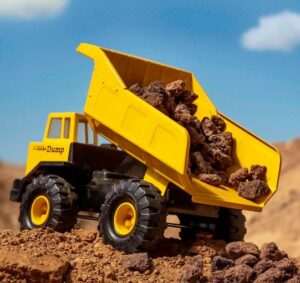
The classic Tonka dump truck is a perennial favourite with boys and girls. Sturdy and tough, the steel trucks last through generations. Image: Basic Fun.
“January of 1935 saw 7 people get shot,” said James Paul in Industrial Artifacts. One surprising culprit was Crounse, who shot 3 workers; Baker was shot through the hand. The brutality was not over. “When none of that subdued the strikers, Crounse and Baker were beaten by the crowd until police intervention.” By the next decade, the managers prepared to start their own business and began the search for a location.
Renovated into a factory by Streater Industries, an older school building was suitable for Baker and Crounse’s venture. Edward Streater began operations by manufacturing ammunition boxes and then changed to toys. His attempt was unsuccessful and “the designs were bulky, made of wood, and would easily break,” said Paul. Along with the building, Streater Industries’ toy designs intrigued the new owners. Crounse and Baker were joined by skilled pressed metal craftsman Alvin Tesch, to found Mound Metalcraft Incorporated. The initial plan was to manufacture garden implements and tie racks.
Tesch examined Streater’s toy designs to see what improvements could be made. The business also hired Charles M. Groeschen, the toy designer that worked for Streater’s firm and had patented several toy inventions. Changing to heavier metal instead of wood increased the toy trucks’ strength, and allowed incorporation of automotive details and moving parts in the designs.
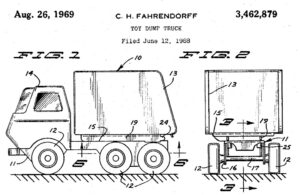
The 1969 patent application drawings for Tonka’s popular dump truck. Image: Google Patents/US Patent Office
The new 1:18 scale toys “were small enough for a child to carry, but large enough to relate to the real world.” The production of garden tools slowed, and toy trucks motored into manufacture in 1947.
That same year, the company acquired the rights to several patents, including “a steam shovel and a crane, which were the first toys they manufactured,” stated Alyssa Thiede at Hennepin History Museum. Through the hard work of only six hustling factory employees, the business produced and sold an amazing number of 37,000 toy vehicles. The company was on to something good.
Introducing a catchy short name, management labelled the toy truck line ‘Tonka’. The name had local connections, partly with nearby Lake Minnetonka, “but also “tanka” meaning “big” or “great” in the Dakota Sioux language,” according to Paul.
The first logo was a horizonal oval shape with Tonka in large slanted red lettering and the smaller company name and location in black. The local graphic designer “incorporated water for the lake and 3 birds representing the three original founders.” Revised over the decades, the logo changed to red, gray, and white, then in 1963, red and gold. The design changed shape, the font becoming bold, white lettering on a rectangular background in 1978, and in 2007 the familiar and immediately recognizable black lettering of Tonka was developed.
Using 20-gauge automotive steel for the first toys, “after WWII, steel was widely available and cheap,” noted Thiede, “and Tonka took advantage of this surplus.” The first tires were heavy solid rubber, and “over the years, modifications were made, like replacing the rubber with plastic.”
Within only a couple of years, corporate politics caused a management shuffle. Co-founders Avery Crounse and Alvin Tesch left the firm in 1952 “when the board of directors declined a rather sweet deal from Tennessee to move manufacturing to the state,” wrote Paul. Baker stepped away a short time later due to poor health, officially leaving the company in 1961. Toy designer Groschen had already left Minnesota in 1957 for a move to Texas. The departure of the original executive team did not hinder Tonka’s upward growth.
The rush of toy sales pushed garden tools out, and in 1955, Mound Metalcraft became Tonka Toys Incorporated. The plant manufactured seventeen lines of toy vehicles, from fire trucks, forklifts, tow trucks, to smaller dump vehicles, pickup trucks and more. “While earning a reputation for durability and realism,” mentioned The Strong National Museum of Play, Tonka Toys “kept up with changes in real-life construction and transportation.”
In the mid-1960s, the operation branched out into barbecue grill production with the acquisition of Mell Manufacturing Company of Chicago, Illinois. Calling the new line “Tonka Firebowl,” the company produced several styles of barbecues, such as “deluxe wagons,” “imperial round,” “backyard models,” and portable “picnic models.” The barbecues were advertised in print publications as “New, from Tonka Toys (for the biggest kid in the family,” and that a Tonka barbecue will “help you cook more delicious foods… and have more fun doing it.”
Barbecue production did not alter Tonka’s main purpose. In 1965, the firm developed the vivid yellow Tonka Mighty Dump Truck. The dump truck, large enough to haul a satisfying load of stuffies, toy cars, or gravel and snow, remains one of the company’s most recognized toys.
Tonka head office moved to larger quarters in Minneapolis, Minnesota in 1968. Within seven years, “Tonka Toys had become a global giant, with facilities scattered around in eight different countries, and the Mound plant employed over 2,000 workers and was still the backbone of the toy manufacturing operation,” said Tom Hauer in “Tough Trucks with a strong Midwest history” on Old Times, November 4, 2019. However, the booming company later made a truck-sized misstep.
Purchasing Kenner Parker Toys, Inc. in 1987, Tonka paid $555 million for the acquisition which included toy giant Palitoy in the United Kingdom. The takeover was financed though extensive loans. Tonka was unable to service the debt, and began the search for a buyer. Four years later, Hasbro Inc. came to the rescue by acquiring Tonka for $516 million dollars, a little short, but still a relief. Manufacturing moved to Pawtucket, Rhode Island, permanently closing the Mound factory.
Hasbro licenced Funrise Toys in 1998 to manufacture and distribute Tonka vehicles. The firm updated versions of Tonka trucks with lights and sound. Video games featuring Tonka products came on the market, along with a range of other Funrise-licenced toys such as Star Fairies, Legions of Power, and others.
The agreement with Funrise Toys ended in 2019, and Basic Fun!® took over the Tonka trucks contract the next year. Basic Fun! as well holds licences for Care Bears, My Little Pony, and other lines. Tonka was honoured in 2001 with induction into The Strong National Museum of Play at Rochester, New York.
Toy truck production moved to China, and the once nearly-indestructible Tonka trucks lost some of their robustness. On June 28, 2024, Basic Fun, Inc. filed for bankruptcy protection under Chapter 11 due to heavy debt load. It remains in business while restructuring.
The rough and tumble Tonka trucks are now available in lighter plastic models and several types feature light and sound. The engaging original metal versions of Tonka trucks have returned to the market, called Steel Classics. They are good fun. No batteries required.
(C) Susanna McLeod. This article first appeared in The Kingston Whig-Standard in March 2024.