
North America’s First Forensics Lab Opened in Montreal in 1914
Forensic scientist Wilfred Dérôme established “Institut de Médicine Légale et de Police Scientifique” to examine crime scene evidence and find the truth.
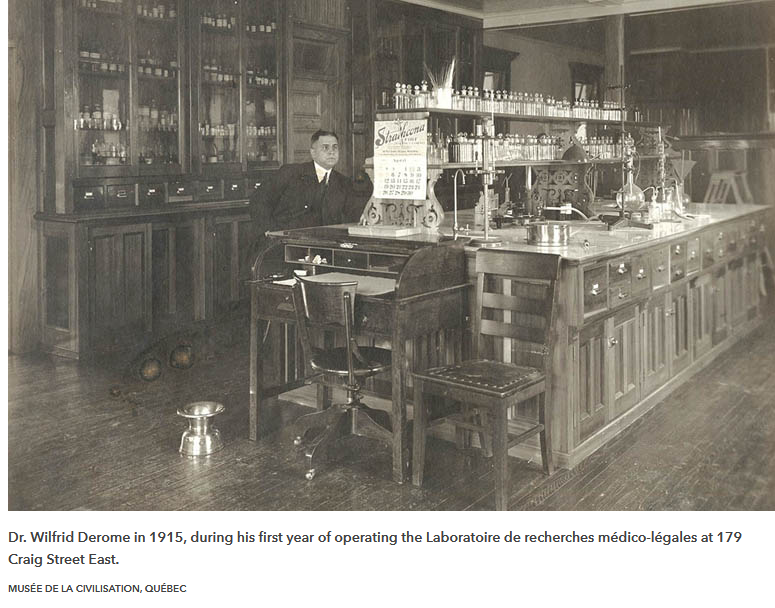
Forensic science took hold in Canada when Dr. Wilfrid Dérôme opened the first forensic lab in Montreal in 1914. Image, 1915, Quebec Museum of Civilization.
For years in the early 1900s, Dr. Wilfred Dérôme worked in the Pathology Lab of the Notre Dame Hospital in Montreal. As the Director of the hospital lab, he examined evidence brought to him and then walked across the street to the Courthouse to give testimony on the findings in cases both low-level and prominent. Fascinated with forensics, Dr. Dérôme took advanced training in 1908, travelling to Paris, France to study at the University of Paris with French experts, Professors Bertillon and Balthazard.
Doctor of Medical-Legal Science
In 1910, Dr. Dérôme returned to Montreal with a fresh diploma in his hand. He was now skilled “in such fields as ballistics, criminal psychology and fingerprint analysis,” said Heather Wright in “Rigorous Science” from The Beaver: Canada’s History Magazine, Feb/Mar 2007. And Wright added, Dérôme “also came back with a dream and the determination to see it fulfilled.” Dr. Dérôme urged the provincial government to establish a forensics facility staffed with qualified scientists and experts to serve the law enforcement community in criminal and legal cases.
North America’s First Crime Lab
Under the authorization of the Attorney General of Québec in July 1914, Dr. Wilfred Dérôme opened a medical-legal laboratory to investigate criminal case evidence. It was not only the first forensics laboratory in Canada, it was the first in North America. The cramped office was initially rented at $75 a month, with a budget of $2,500 allowed for equipment, according to Doug Lucas’ research paper given at California Association of Criminalists in May 1996.
Dérôme was Forensics Expert
As Director of “Institut de Médicine Légale et de Police Scientifique” Dr. Dérôme gave his full attention to autopsies and biological testing, to fingerprint examination and firearms investigations. In 1922, an Assistant Director was hired; Dr. Rosario Fontaine brought his skill in document assessment to the institution. (Fontaine was promoted to Director of the crime lab in 1931.) Two years earlier, Franchere Pepin joined the ground-breaking forensics lab, adding significant chemistry and toxicology skills to the services offered to criminal investigators. One of the scientists’ first advancements was the creation of tests for blood alcohol levels. The tests underwent many refinements over the years.
The Quebec facility provided investigations for Canadian clients and also received requests from the United States, hosting FBI Director J. Edgar Hoover on two occasions. The FBI Crime Lab opened in 1932. The Royal Canadian Mount Police, noted the Canadian Society of Forensic Science, opened their own crime lab in Regina, Saskatchewan in 1937.
Crime Lab Combined with Sûreté du Québec
“Institut de Médicine Légale et de Police Scientifique” moved to larger quarters in 1924 and in 1968, united their operations with the provincial police, moving into modern laboratories in the Sûreté du Québec headquarters on Rue Parthenais in Montreal.
Dr. Wilfred Dérôme, Author
The author of several books and scientific articles in legal medicine, Dr. Wilfred Dérôme wrote “Precis de Medecine Legale” (Handbook of Legal Medicine, 1920) and “Expertise en Arms a Feu” (Expertise in Firearms, 1929). Dérôme was born on April 19, 1877 in Napierville, Quebec. Graduating from several universities, he received a Doctorate in Medicine from University of Montreal in 1902. On return from France in 1910, Dr. Dérôme was named the university’s Professor of Legal Medicine and Toxicology.
Unfortunately, the pioneer of Canadian crime labs missed the expansion and development of the institution that he loved. Dérôme died of cancer at age 54 on November 24, 1931. His name lives on as the title for a government building in Montreal and in the background of renowned author Kathy Reich’s crime novels, and television shows, such the “Wilfrid Derome Building” on Bones.
This article first appeared on Suite101.com in April 2010. (C) Susanna McLeod