
Elizabeth Bertrand Mitchell, Heroine in War of 1812
The Métis wife of a British army doctor, Elizabeth Mitchell enlisted her Ottawa tribe members as allies against the American invasion in southern Ontario.
In the same year as the signing of the American Declaration of Independence, another smaller, happy union was being forged in July 1776. Fifteen-year-old Elizabeth Bertrand was wed to Dr. David Milligan, a twenty-six-year-old physician and surgeon with the British Army stationed in North America. Dr. Milligan was born in Scotland and arrived in the Colonies in about 1771. His young bride was Métis, her father the French fur trader Joseph Laurent Bertrand, her mother Marie Joseph Lamaire of the Chippewa. Elizabeth grew up at L’Arbre Croche near Fort Michilimackinac.
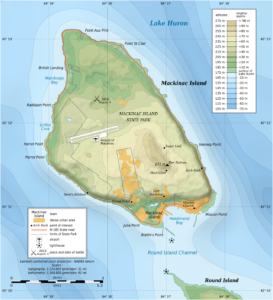
Topographical map of Mackinac Island in Lake Huron, near Michigan, USA. Eric Gaba, Wikimedia Commons
Mitchell Home on Mackinac Island
The Mitchells moved to Mackinac Island in 1780 when the doctor was appointed Deputy Commissary for the small fort. Good friends with the new Lieutenant Governor Patrick Sinclair, Mitchell received several parcels of land on the island. “In 1781 the sloop Welcome had transported Mitchell’s house timbers to Mackinac Island and he constructed a large, gambrel-roofed house on Market Street,” said David A. Armour in Dictionary of Canadian Biography Online. (A gambrel roof is a gable-style that changes slope partway down, often used for barn roofs.)
Living prosperously on Mackinac Island, the Mitchells did not want to move when the region was handed over to the Americans under Jay’s Treaty in 1796. The Mitchell home was a happy hub of social activity, hosting dinner parties, galas and festive events. By this time, the children of David and Elizabeth were growing up, the boys taking jobs in trading and helping their family’s businesses. (The Mitchells had twelve children, many of whom were educated in Montreal and Europe.)
In 1811, Mitchell rejoined the British army at St. Joseph Island, working in the military hospital. The rumours of war turned into threats, and on June 18, 1812, US President Madison declared war against the British. Canada was the handy target.
Elizabeth Mitchell Enlisted Ottawa Relatives
In one of the first skirmishes of the war on July 17, 1812, Mitchell participated with the troops in the taking of Fort Michilimackinac – near his own home. The British moved into the established garrison and Mitchell continued his hospital work there. In 1814, the American soldiers attempted to regain the island of Mackinac. Elizabeth Mitchell swung into action at the danger and enlisted the help of her Ottawa tribe relatives as allies of the British.
British Commendation for Elizabeth Mitchell
“During the War of 1812, her [Elizabeth Mitchell] ability to recruit native military assistance won her a commendation and a medal from the British,” said War of 1812 in Algoma in “Women and Families.” Although the island was won by the Americans, Mitchell was a heroine for her efforts. She received £50 a year for two years for her service to the British government. Also appreciated by the Ojibway, in the fall of 1814 Mitchell was given a deed to a traditional burying ground on nearby Round Island.
Persecuted by Major Puthuff, Indian Agent
After the war ended, the influence Mitchell held with the natives did not go unnoticed by Major Henry Puthuff, the new Indian Agent for the United States on Mackinac. Mitchell’s husband was away working in Drummond Island.and Puthuff felt free to persecute Elizabeth. He claimed she was a British spy. The Major posted a notice on the church door that she was prohibited from “holding council” with her Indian family and friends. Mitchell’s kin continued to visit. Angry letters flew between authorities on both sides, and by Dr. Mitchell, to no avail.
Mitchell Fled by Canoe
Threatened with arrest and a trial, Elizabeth Mitchell “fled at night in a small canoe to join her husband,” said Armour. Remaining on Drummond Island until it was safe – from 1815 to about 1817 or the year earlier – Mitchell returned to her beloved home at Mackinac.
Dr. David Mitchell remained with the garrison on Drummond Island until he moved to Penetanguishene, Ontario in 1828. The patriotic doctor died in 1832. Elizabeth Mitchell continued the prosperous family trading business on Mackinac Island with help from her sons. Recognized as one of the brave women during the War of 1812, she died in 1827 at age 66.
Sources:
- Armour, David A., “Mitchell, David,” Dictionary of Canadian Biography Online Accessed June 20, 2012
- “Women and Families,” War of 1812 in Algoma Accessed June 20, 2012
- Barkwell, Lawrence, “Elizabeth Bertrand Mitchell, (1761-1827),” Scribd Accessed June 20, 2012
This article first appeared on Suite101.com on June 21, 2012. (C) Susanna McLeod