
Opening the Toy Chest: Jumbo Block Won the Hearts of Toddlers
Away from the limelight, a small company opened in Montreal, Quebec in 1967 to distribute toys manufactured outside of Canada, and to act as intermediary between international and Canadian toy firms. Ritvik Holdings branched out to designing and manufacturing toys, and by the early 1980s, developed a new building block toy. Exhibited at trade shows in 1984, Mega Bloks® won the orders of store buyers and the hearts of toddlers. However, as the firm added new lines of smaller block sets, Ritvik ran into legal hurdles.
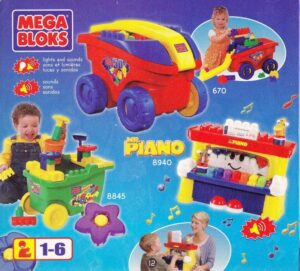
Competing with the likes of Lego(TM), The Montreal firm Ritvik introduced Mega Bloks for the toddler market. Page from the 2001 Mega Bloks catalogue, featuring the piano. Mega Blokcs/Archive.org. https://archive.org/details/mb2001catalog/page/n11/mode/2up?view=theater
Victor Bertrand and his wife Rita combined their first names to create the company name of Ritvik. An industrious teenager at age 17, Victor Bertrand (b. 1943) attended school in the evenings and worked during the daytime to help support his parents. Employed in the toy business, “by the age of 20, Bertrand was already very knowledgeable about the toy industry, plastics, and injection molding,” stated Encyclopedia.com. “In 1967, he was confident enough to start his own toy distribution company.”
Distributing toys for foreign manufacturers, Bertrand also brokered deals for Canadian companies to manufacture products for international toy firms. Broadening its footprint, Ritvik expanded into manufacturing. The company already owned “plastic injection molding operations, design operation, tooling manufacturers, and marketing services,” described Encyclopedia.com. Within a few years, Ritvik Holdings claimed a large slice of the injection-molded toy pie in Canada, and was reaching for a piece of the international market.
Bertrand observed the perennial sales growth of block toys. In particular, the colourful interlocking bricks of Lego® intrigued the inventor. The Danish toy devised by Ole Kirk Christiansen in 1932 was recognized around the globe, and Lego sales were soaring. Bertrand was inspired to compete, with a design change.
Lego bricks are small with interlocking studs, useful for all kinds of creative kids’ projects but too small for young children to enjoy. Aware of the choking hazard small blocks presented for toddlers, Bertrand scaled up the Lego design, making a block with jumbo interlocking nubbins. Applying his skills as a plastics molder, he produced a prototype set of colourful, plastic bricks. Ritvik could produce and sell the toy at a competitive price, cheaper than Lego retail prices. Ritvik company chose a name that perfectly described their new toy: Mega Bloks.
Although his advisers counselled against the venture, the toymaker pressed on. Attending trade shows in Canada in 1984, Bertrand’s toy blocks were an immediate success. Sales rocketed across the country as retailers recognized the value of safe and creative blocks for the toddler market. Within two years, an international toy titan came calling.
“In 1986, when my father made his first journey into international sales from Canada, it was Charles Lazarus (the founder of Toys R Us Inc.) who noticed his tiny display in a crowded showroom,” said Bertrand’s son, Vic Bertrand Jr., in Toy World Magazine, November 2019.
Lazarus submitted the first American order for Mega Bloks, a whopping $1 million request. Ritvik Holdings was now playing with the big boys.
“Several multinational companies asked to either buy the distribution rights to Mega Bloks or to buy Ritvik Holdings outright,” company founder Victor Bertrand “told Canadian Business Magazine (November 1993),” said Company-Histories.com (Wayback Machine/Internet Archives). Declining all offers, the businessman used the new toy as “the cornerstone of a long-range plan to bring the company into wider markets.
Selling in 30 countries including Canada, United States and Europe, Bertrand’s development faced stiff competition from Lego and Duplo®, their jumbo brick brand. The Ritvik company introduced Mega Bloks play sets and created “preschool toys, such as a piano with Mega Bloks keys that could be integrated into other Mega Bloks construction sets,” Company-Histories.com said. Selling off the firm’s other toy lines, Ritvik Holdings made Mega Bloks its singular product. However, they were about to step on the toes of their largest competitor with their next endeavour.
Designing Micro Mega Bloks® sets with smaller bricks, Bertrand developed a line of construction toys for the 8-to-14 ages of kids. Not only similar to original Danish bricks, the smaller Mega Bloks bricks could be used interchangeably with Lego. That was it for Lego. Although the patent for the classic brick design had expired, Kirkbi AG and Lego Canada sued Ritvik Holdings in 1996 for unfair competition.
“The lawsuit hinged on the claim that Ritvik had caused confusion between its Micro Mega Bloks and Legos,” noted Encyclopedia.com. “The case was not decided for years, during which time sales of Mega Bloks continued to grow around the world.”
In 2005, courts in Canada deemed that Ritvik had done enough to distinguish the toy brand from Lego, thereby not overstepping the Trademarks Act. “European and U.S. courts came to a similar conclusion in other cases brought by Lego.”
A family business, Bertrand’s sons Marc and Victor Jr. were in management, and in 1996, Rita Bertrand retired. The Quebec company flourished throughout the 1990s, licencing characters, such as favourites from Sesame Street and Teletubbies in Britain, and signing race car drivers, as well. The firm produced advanced kits with electronics, and sets that transformed into vehicles. Television ads appeared in 2000, and “by 2002, the company was spending almost $30 million annually on advertising, marketing, and research and development,” according to Company-Histories.
Ritvik Holdings became Mega Bloks, Inc. in 2002, along with the initial public offering on the Toronto Stock Exchange. Marc Bertrand became president and CEO, and his brother Vic Bertrand Jr. was appointed chief operating officer; their father was at the helm as chairman of the board.
Innovations and expansion continued as the company entered new markets in Latin America, Japan, Hong Kong and South Korea. Mega Bloks leaned into the fantasy segment of the marketplace with Lord of the Rings and Harry Potter kits plus all sorts of accessories. Reflecting the changes, Mega Bloks, Inc. became Mega Brands Inc. in 2006.
In January 2014, toy conglomerate Mattel Inc. purchased Mega Brands for $460 million, with the agreement that company headquarters would remain in Montreal. For a time, Mega Bloks was the largest toy manufacturing facility in North America. The factory manufactured Mega Bloks toys until 2021, when production was moved to Mexico and China. About 580 jobs were lost in the streamlining, but about 230 employees remained in administration and design.
In 2019, Vic Bertrand Jr. became president and CEO of Toys R Us Canada, the firm valuing his lengthy experience with international retailers and understanding of the dynamic kids’ marketplace.
Among philanthropic legacy projects, The Rita & Victor Bertrand Foundation established a generous bursary at Montreal’s West Island College. (WIC) The bursary “is awarded to deserving students throughout their entire journey at WIC,” noted Marie Leduc in WIC’s News on October 31, 2023. The award “goes beyond mere financial support; it embodies the unwavering commitment of the Bertrand family to education as a means of empowerment and personal growth.”
A wildly successful business venture, Mega Bloks® remains one of Canada’s favourite construction toys, encouraging creativity in the hands of little kids and their parents.
(C) Susanna McLeod 2025. This article first appeared in Kingston Whig-Standard in September 2025.