
Opening the Toy Chest: Table Hockey Sets Manufactured in family’s basement
Claiming the title of the birthplace of hockey, Montreal, Kingston, and Windsor, Nova Scotia each has a long history with the sport. The invention of table hockey is much easier to narrow down. There is only one birthplace of the indoor hockey game in 1932: the Toronto basement of Donald Hill Munro Sr.
In the middle of the Great Depression when money was in desperately short supply, purchasing Christmas gifts was not a priority. The Munro household had several kids, but what gifts to get them to celebrate the season? The Scottish-born owner of a fish and chips shop had an idea. He drew up plans for a challenging indoor game.
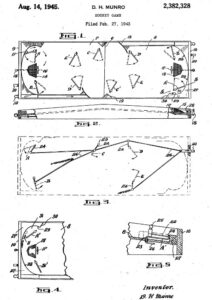
DH Munro received US Patent No. 2,382,328 on August 14, 1945 for his captivating mechanical table hockey game. The wooden game board and pieces were produced in the home basement by family for many years. US Patents/Google Patents.
Using bits and scraps from around his house, Munro built a mechanical table hockey game, about 14” x 36” in size. (34.5cm x 91.4) Munro’s “creation was a kind of two-sided pinball, with levers to move three players with the right hand and a goalie with the left,” wrote Lance Hornby in “The story of table hockey,” Toronto Sun, April 4, 2016.
“It was basic. It was crude, but a lot of fun to play,” William Munro was quoted by Elliot Avedon in “Virtual Museum of Games,” University of Waterloo. A three-quarter-inch piece of lumber from the home’s coal bin provided the sides and end of the initial rink. The playing surface was possibly a 1/8” piece of birch plywood over “a solid plank undersurface butted end to end.” It was slightly peaked at the centre. Scrap metal strapping turned into deflectors. Clock springs became shooters. And butcher cord turned into control wires under the surface.
Munro enlisted his wife to sew bias tape on the edges of green mosquito netting. She then placed it over wires to represent the goal nets. Pot lid knobs were put to use as player controllers. At first, the players were represented by lifeless pegs, allowing movement to swat at the “puck,” symbolized by a steel ball.
The Munro kids loved it. When the puck dropped, hands operating the steel flappers went wild. The family didn’t think of manufacturing the game to sell until a record salesman knocked on the door, Hornby said. The salesman saw the table hockey set and recommended that Munro show his invention to Eaton’s Department Store managers. Taking the streetcar to the downtown store, Munro took a shot. Score! “A purchaser ordered one on the spot for $3.60 and by the time Munro was home, requested six more,” noted Hornby.
The novice manufacturer applied for a patent in 1936 and established Munro Games Limited.Family members and friends gathered to help produce table hockey sets in the home’s basement. Business flourished. The family moved several times to accommodate production in larger basement space until they found a Quonset hut in Burlington, Ontario. When Munro’s sons returned from wartime duty, they joined the firm and helped to modernize the factory.
Sold across the country by Eaton’s, the Munro Standard Model hockey game was listed for $4.95 each in the 1939/40 Fall/Winter catalogue. Continuously making design improvements, Munro produced a DeLuxe version of table hockey in 1940, “where the ball would roll out of the net after a goal and into a small cut mounted at each end of the game,” said Steve Farar’s webpage article, “The Complete History of the Most Realistic Mechanical Sports Game Ever Devised,” quoted by Clan Munro Association of Canada. Issued a US patent in 1945, Munro joined with Stewart M. Robertson of Rochester, New York to manufacture the popular Canadian game. There was no scoring in America. Oddly, US sales were a flop.
Meanwhile, sales in Canada soared. Growing by several thousand games each year, the most popular item was the DeLuxe version. Also manufacturing a Club game for extended use, a rink “with a heavier wooden frame and stronger wire parts was introduced for the many Boys Clubs that existed in Canada at this time,” mentioned Peter Reynolds of Oldtime Games in “General history of tabletop hockey games.”
By 1952, before television screens occupied audiences, “there were an estimated 146,000 sets in the country,” Hornby said. Munro games featured Toronto Maple Leafs versus Montreal Canadiens, with metal cut-out hockey players in colourful jerseys moving in fast action. The founder’s sons, William and Donald Jr., took over leadership of the company, receiving a patent in their names as inventors in 1957 for game modernizations. In the same decade, the new medium of television began broadcasting hockey games, inspiring further game improvements, but also sparked table hockey competitors.
Other companies began to produce their own versions of table hockey, taking shots at Munro’s market dominance. Montreal company Eagle Toys presented a real threat with their table hockey set and creative marketing. The Eagle game was larger, measuring 16” x 36” (40.6cm x 91.4cm) and sold for nearly $11. For many years, the two companies ruled table hockey manufacturing. Eventually, international firms entered the market, such as table hockey sets from Sweden.
While Munro had the endorsement of distinguished individual players such as Bobby Hull and Bobby Orr, Eagle company executives made deals with NHL teams to use logos and jersey images, plus received over $7,000 in funding.
Industrial spies infiltrated the Munro facility. “Parts were stolen and re-assembled,” Hornby wrote. “Security firms such as Pinkerton were brought in to guard secrets,” and lie-detector tests were given to workers. However, “Munro’s strength had been its durability, starting with spindle gears, developed in the ‘60s and still used today.” Eagle and Munro individually made game improvements; eventually the firms called a truce
The horn sounded in September 1968 when Munro Games Limited was purchased by Servotronics in Elma, New York. Nearly at the same time, Coleco Industries in Connecticut, New York bought Eagle Toys. The table hockey manufacturing game ended in Canada. Munro-brand table hockey games were produced by Servotronics for nearly a decade, then the brand was phased out in 1977.
Table hockey remains an exciting popular game nationally and internationally. Munro table hockey games are now treasured collectibles.
(C) 2024 Susanna McLeod. This article first appeared in the Kingston Whig-Standard in August 2024.