
Opening the Toy Chest: The Colouring Magic of Binney and Smith
Understanding the needs and desires of customers was a crucial business advantage for Edwin Binney and Harold Smith. Establishing a partnership in 1885, the Binney & Smith firm transformed from producing dull charcoal and lampblack paints to wax sticks in a burst of vibrant hues. Stacked on shelves, tucked in toy boxes, strewn across the floor, the yellow and green boxes are familiar in Canada and recognized worldwide. Get out your crayons and drawing paper, and let’s discover the early history of Binney & Smith’s Crayola®.
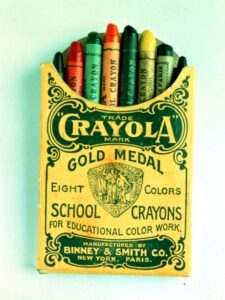
Businessmen Joseph Binney and C. Harold Smith produced crayons for classrooms in 1903, a pack of eight brightly coloured sticks in wax. Photo: Crayola LLC/LinkedIn.
Settling in the eastern USA in 1860, Joseph Binney (b. 1836) was a well-educated immigrant from Wakefield, England. In 1864, he opened Peekskill Chemical Works at Peekskill, New York, about 55 kms north of New York City. The company manufactured dyes, inks, and paints, making sooty lampblack and charcoal into pigments, and also produced red oxide pigment for barns and buildings. Joseph and his wife Annie welcomed their son Edwin at Shrub Oak, New York on November 24, 1866. The senior Binney moved his industrial operations to New York City.
When young Binney was 17, he was hired as a travelling salesman with a paint firm, according to Jennifer Blizin Gillis in Edwin Binney: The Founder of Crayola Crayons (Heinemann Library 2005). Two years later, he opened a natural gas company, merging with other operations to form a larger business, with Binney as president. Around that time, Joseph Binney was preparing to retire from Peekskill Chemical Works. His son Edwin and older nephew Charles Harold Smith stepped in to lead the factory, bringing a new title and fresh concepts.
Joining names, Binney & Smith was founded in 1885 and incorporated in 1902. Also in 1885, Binney married teacher Alice Stead (1866-1960), a young woman originally from London, England. The couple built a stately home in Old Greenwich, Connecticut and began their family, welcoming three daughters and one son.
Business partner Harold Smith was born in London, England in 1860. Living in New Zealand for a few years, he then immigrated to the United States in 1878. Marrying Paula, the pair had two children. The manufacturer was outgoing, enjoying travelling and forming friendships wherever he went. Smith was an author, including his travel notes in his books. “He wrote several fictional and philosophical books which aroused interest from the public, particularly his autobiography which gave a glimpse into his personal philosophy,” stated Smith’s biography on Encyclopedia.com. (Published by Appleton in 1929, Smith’s autobiography is titled The Bridge of Life.)
At the New York plant, the partners established the Pigment Division and “introduced carbon black for reinforcing automobile tires,” said National Inventors Hall of Fame in “Edwin Binney.” Before the pigment was offered, “tires were typically white.”
The inventive entrepreneurs developed machinery specific to their requirements, preventing waste and loss of time. Carbon black was made from burning gas, and lampblack was made by burning oil. Mechanical scrapers collected cooled residue from chambers, and conveyors moved the materials to a desired location. The machinery could operate continuously, “the power required for working the conveyers and scrapers is small, and the number of attendants or operators very few,” noted Binney’s patent submission. U.S. Patent No. 453,140 for ‘Apparatus for the Manufacture of Carbon-Black’ was issued on May 26, 1891 jointly to Edwin Binney and Harold Smith,
Supplying slate pencils for writing on school slates, the company purchased a mill on Bushkill Creek at Easton, New York in 1900, about 185 kms southwest of Peekskill. Excavating the fine-grained metamorphic rock, Binney & Smith workers then ground slate into a powder using the water-powered stone mill, then pressed it into pencils. Teachers and students also inspired the company to invent another beneficial product for the classroom.
Chalkboards and chalk were essential classroom tools, but chalk dust particles floated through the air, leaving residue and perhaps breathing problems. Binney and Smith devised a dustless chalk in 1902 that was compressed and extruded, named An-Du-Septic chalk. Exhibiting the product in the St. Louis World’s Fair in 1904, Binney & Smith won a Gold Medal for their innovation. And they won a big market share of chalk in schoolhouses, too.
Touring schools, the businessmen learned that art supplies were needed, such as wax sticks with vivid colours. The firm already produced a chunky wax crayon, but it was made with toxic ingredients. It was only for industrial purposes, not geared for the smaller hands of children. Realizing that schoolkids needed safe, colourful crayons in the classroom, the innovators began research into “non-toxic pigments to colour the wax,” noted Encyclopedia.com. The engaging product became the foundation of the company.
On June 10, 1903, the first Crayola crayons emerged from the production line. The soon-to-be-famous trademarked name ‘Crayola’ was coined by Binney’s wife, Alice, by combining the French word “craie” (for chalk) with “ola” (for the oleaginous paraffin used for the stick). The original small boxes of colouring magic contained wax sticks in blue, violet, green, brown, red, yellow, orange and black—the pack of eight sold for five cents. Sales soared. Binney & Smith wasted no time in introducing a sixteen-crayon pack for ten cents.
Innovations abounded. In the 1920s, the company added supplies for art students and fine art crayons that could be sharpened. They added a line of art paints, and by the mid-1930s, Binney & Smith was a founding member of the Crayon, Watercolor, and Craft Institute, Inc. The organization’s mission was to promote safety in art materials production.
Operating their large four-storey factory at Easton, the firm hired generations of local workers, including women. During the financially-overwhelming Great Depression, Binney & Smith kept the factory open, only cutting back shifts by one day per week. The manufacturer “also gave farmers work, packing crayons,” mentioned Gillis.
Families of farmers were also employed in production, said Encyclopedia.com. “The families drew the labels for the crayons; each family taking a different colour. Soon each farm became associated with their particular Crayola colour.”
Missing the grand future of his company, industrialist Harold Smith died at age 71 in 1931. A generous philanthropist, he participated in many civic organizations in the New York region. His founding business partner also did not survive to see the amazing growth of their enterprise.
Throughout his corporate career, Edwin Binney was known as kind and philanthropic. He donated a park with baseball fields to the town of Old Greenwich and in memory of their son, Edwin Jr. who died at only age 29, the Binneys donated the Parish House to the First Congregational Church of Greenwich in 1931. Three years after Smith’s death, 68-year-old Edwin Binney died on December 17, 1934. He succumbed to a heart attack on his way home from visiting a grandson in Florida.
Alice Binney continued her husband’s charitable work, giving “a two-car mobile first-aid post to be operated by the American Ambulance Service in Great Britain during WW2,” stated her obituary in New York Times. Enjoying music, Mrs. Binney published several musical compositions, and was founder of Greenwich Historical Society. On September 9, 1960, Alice Binney died at age 94 at home on Binney Lane.
In 1926, Canada Crayon Company was established in Toronto. As it grew, the manufacturer moved to Peterborough and then to Lindsay, Ontario. In 1934, the business acquired the rights to manufacture and distribute Crayola brand products. “In 1958, the Canada Crayon Company became a wholly owned subsidiary of Binney & Smith,” according to Maryboro Lodge Museum, November 5, 2022. The factory was demolished, but Crayola Canada’s headquarters is still located in Lindsay.
The Pigment Division was sold in 1955, directing the firm’s energy to profitable art supplies and Crayola products. In 1961, Binney & Smith became a publicly-traded company. The business name of Binney & Smith Inc. was retired in 2007, the manufacturer becoming Crayola LLC to represent their flourishing brands. Established in 1903, the company now produces markers, paints, crayons, and every sort of creative supplies imaginable. Edwin Binney and Harold Smith would surely be impressed.
(C) 2025 Susanna McLeod. This article first appeared in the Kingston Whig-Standard in June 2025.