
Opening the Toy Chest: The Golden Age of Jigsaw Puzzles
Everyone has a favourite way to start. Some begin with a central section, joining a tab and a blank to work outward on the jigsaw puzzle image. Others begin with flat-edged corner pieces and interlock from the perimeter inward. Regarded as the first to produce jigsaw puzzles in the mid-1700s, British cartographer and publisher John Spilsbury sparked the world-wide passion for puzzles.
In 1753, 14-year-old Spilsbury began an apprenticeship with leading cartographer and engraver Thomas Jefferys in London, England; the top in his field, Jeffreys (circa 1719-1771) was the “Geographer to King George III” said Musee National des Beaux-Arts Du Quebec. Spilsbury sharpened his craft during a seven-year training span, learning the engraving and publishing trade, plus geography and map-making. Adding confusion, the apprentice’s older brother’s name was Jonathan Spilsbury (about 1737-1812), also an engraver, artist, and miniaturist.
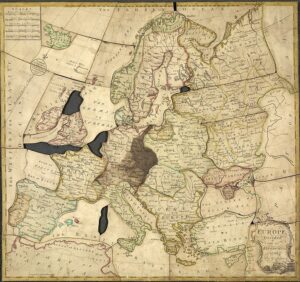
The first jigsaw puzzle was introduced by publisher John Spilsbury in Britain in 1766, as an aid for teaching geography to upper society children. British Library, ID #062581. Flickr Creative Commons.
Completing his training in 1760, John Spilsbury opened a shop “in Russell Court, of Drury Lane,” according to the British Museum, and he “worked in the children’s book trade.” The next year, the young man married Sarah May from the historical community of Newmarket, Suffolk. Among his offerings, Spilsbury “published maps, charts, stationery, printed silk handkerchiefs,” and much more.
In 1766, the publisher devised an idea to help children learn geography. Spilsbury printed and hand-coloured a world map, mounting it onto a wood board. Using a hand-held marquetry saw with a curved blade holder, he carefully cut around each country to transform the map into what is widely considered the first jigsaw puzzle. Certain references note that teacher Madame de Beaumont of Paris, France made similar puzzles a decade or more before Spilsbury designed the educational game. (Spilsbury was working about hundred years before electricity was even powering lightbulbs. Locally, Kingston Electric Power Company was incorporated in 1866 and established the electric light plant on lower Brock Street two years later.)
Spilsbury also missed out on mechanical cutting by a century. The treadle-operated jigsaw came along in 1855, according to librarian Tina Lerno with Los Angeles Public Library’s blog, December 6, 2021. “Jigsaw came from the nickname jig, which was used because of the saw’s ‘rapid up-and-down motion.’” It resembled “an old-fashioned sewing machine with a blade instead of a needle.”
Dubbed a ‘map dissector” producing “dissected maps,” Spilsbury created geographical puzzles that sold for a royal price. His maps were initially “used to teach geography to the children of King George III and Queen Charlotte by their governess Lady Charlotte Finch,” said editor Caitlin Dempsey in “Dissected Maps: the First Jigsaw Puzzles” at Geography Realm. Decades later, puzzles became more affordable for the public, and “…cardboard started to replace wood as the back of choice which lowered the cost of the puzzles.”
Along with the less-expense picture backing, in the late 1800s advancement s in the equipment to die-cut the cardboard emerged, cutting the materials into many small pieces at once. Similar to cookie cutters, cutting dies were affixed to a metal plate attached to a press machine. Rapidly punching down with enormous force, the puzzle pieces were stamped out in the desired shapes. By the early 1900s, both cardboard and wooden puzzles were on the market, however manufacturers enjoyed much higher profit margins from the wood puzzles.
The name ‘jigsaw puzzles’ emerged in 1906. At the same time, sales flourished. “The Golden Age of jigsaw puzzles came in the 1920s and 1930s,” wrote D.J. McAdam at American Jigsaw Puzzle Society. Manufacturers produced scenic puzzles, and also featured the public’s fascination with trains and ships. Expanding the customer base, marketers focussed on the adult market. Manufacturers produced more complicated images with smaller pieces to engage the grown-up customers, while still maintaining the popular children’s market.
Publishing jigsaw puzzles for advertising, companies such as Great Western Railway created railway puzzles in the 1920s, and “Cunard Cruises, who started to make postcard-sized puzzles that they sold on their cruise liners as souvenirs,” stated Puzzle Lab’s blog. “These puzzles were sold in boxes with images of the finished product on them which was a first!” Before this, puzzlers were working blind to develop the image emerging before them.
In the early 1930s, “manufacturers produced 10 million puzzles a week,” described Lerno. “People could rent puzzles for a nickel a night.” Jigsaw puzzles have become household standards, with “brands like Ravensburger, one of the top puzzle companies, selling over 28 million puzzles worldwide in 2020 alone.”
Today’s puzzle market is booming. According to Statista, the worldwide revenue for puzzles “that require users to assemble pieces into a complete picture, shape or design,” is estimated to be over $3 billion, with an projected annual revenue in Canada of just under $60 million. The annual estimated Canadian growth rate is 2.86%. These numbers represent a shelf load of puzzles in homes.
Puzzle designers such as Wrebbit Puzzles Inc. in Montreal, Quebec have taken the flat image design into three-dimensional puzzles in different materials. In 1991, Paul Gallant invented “the first 3D puzzle, made of foam-backed jigsaw puzzle pieces,” said the Wrebbit site. “He branded his new invention Puzz3D.” Several more Canadian jigsaw puzzle manufacturers include JaCaRou Puzzles in Quebec, Cobble Hill Puzzles with headquarters in Victoria, B.C, Fits Puzzles in Vancouver, B.C., and others.
For really serious jigsaw puzzlers, The Canadian Jigsaw Puzzle Association might be the place for you. (Visit CJPA at https://www.canadianjpa.ca/.) The non-profit group holds events, contests, socials, and monthly “Puzzle Along” held on Facebook. The Association is registered with the World Jigsaw Puzzle Federation, which holds annual international championships. The 2025 world championship will be held in mid-September in Valladolid, Spain.
Entertaining, soothing, maybe even aggravating, jigsaw puzzles are an escape from the busy world, for a single puzzler or a collection. But the eternal question still lingers: where did that single piece go! The challenge of jigsaw puzzles is enduring. Grab a new puzzle, or pull the image apart on he one you enjoy, and click the pieces together again.
(C) 2025 Susanna McLeod. This article first appeared in the Kingston Whig-Standard in July 2025.