
Paraskeva Clark: Painting Canadians at War and Work
Imbuing paintings with colour and emotion, Paraskeva Clark also added dashes of political views. She was one of Canada’s most talented artists of the 1930s and ’40s.At the end of her long and flourishing career as a prominent fine artist, Paraskeva Clark made startling statements.
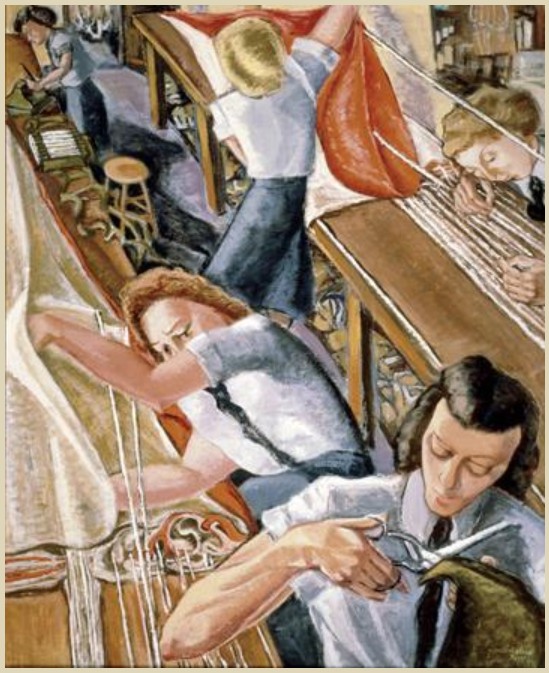
Oil on canvas 101.8 x 81.4 cm, painted in 1947
Beaverbrook Collection of War Art, Canadian War Museum 19710261-5679 (One of this writer’s favourites.)
Difficulties Faced by Women Artists
“I would like to stop every woman from painting, for only men can truly succeed,” Paraskeva said, adding, “The majority of women who have really succeeded have not married or had children, but I don’t envy them.” The “natural duties” of family – husband, children and other responsibilities – made it nearly impossible for women to immerse themselves in artistic lives, thought Paraskeva, so much so that “they cannot truly gather that great volume of creative effort needed for truly great works of art.” The artist spoke from the depths of her heart, fully understanding the investment required to raise and care for a family, especially one with serious problems.
Born Paraskeva Plistik in St. Petersburg, Russia in 1898, the little girl was of Russian peasant stock. “Her father, Avdey Plistik, worked in a factory and later owned a grocery store…her mother, Olga Fedorevna Plistik, was an expert in the old Russian folk art of artificial flower-making,” according to the Collections Canada entry “Paraskeva Clark” in “Celebrating Women’s Achievements.” Paraskeva’s father “instilled in his daughter a love of books and learning.”
Paraskeva Plistik Trained in Russia
Well educated, Paraskeva was able to attend secondary school. Initially setting her sights on a career as an actress after graduation in 1914, Paraskeva instead worked at a shoe store during the day and took art classes at the Petrograd Academy of Fine Arts in the evening. Two years later, she was able to afford private lessons with Savely Seidenberg, a landscape painter. During those years, Russia was in political and economic turmoil. In the Russian Revolution of 1917, one of the country’s famous art academies became the Free Studios. Paraskeva attended without tuition fees from 1918 to 1921, and gained a firm education in the intricacies of fine art.
Hired to paint theatre sets in 1922, Paraskeva met and married scene painter Oreste Allegri Jr.; their son Benjamin was born the next year. The family was about to move to Paris, France when tragedy interfered – Paraskeva’s husband Oreste drowned. The newly widowed young mother gathered up her son and moved to Paris in the fall, joining her in-laws there.
No time to spare for painting, Paraskeva worked in her in-laws’ home and in a Paris interior design store. In 1929, a Canadian accountant entered the store and captured Paraskeva’s heart. Married in London, England in June 1931, Philip Clark took his bride and her son, Ben, to Canada. Toronto became Paraskeva’s new home and the launching point for her career in art.
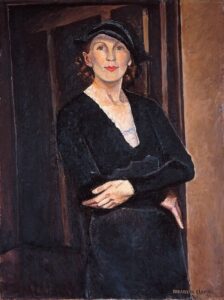
Self-portrait of Paraskeva Clark, painted in 1933, oil on canvas, 101.6 x 76.7 cm. National Gallery of Canada, 18311.
Meeting the Group of Seven
The Canadian masters of the arts were not strangers to Paraskeva’s husband. Meeting several members of the Group of Seven and other artistic lights, Paraskeva was inspired to paint again. Her first entry in a showing was a small self-portrait, displayed at the Art Gallery of Toronto in the Royal Canadian Academy’s annual exhibit in November 1932. The next year, while pregnant with her second child, Paraskeva painted “Myself,” a boldly dramatic oil, considered to be one of her masterpieces. (The Clarks welcomed their new son, Clive, born in June 1933.)
Invited to join the Canadian Group of Painters (evolved from the Group of Seven, noted Collections Canada, Paraskeva exhibited her varied paintings in oils and watercolours with the group for nearly 30 years. Her beautiful, captivating works would grow to include action scenes, still-lifes, portraits, landscapes and war art.
Painting RCAF Women in Trenton, Ontario
Paraskeva held strong political views that emanated from her paintings. Painted in 1937, “Petroushka” became one of her most famous politically-opinionated paintings, created after Chicago police killed five steelworkers on strike. World War Two drew Paraskeva’s attention, causing her great concern for her homeland of Russia and for Canadian-Russian relations. “In May 1944, she wrote to Harry McCurry at the National Gallery to express her disappointment at not being chosen as a civilian war artist,” said Jennifer Morse in “War Art: Paraskeva Clark,” Legion Magazine, November 2004. McCurry “agreed, and eight months later she was commissioned to paint the activities of the Royal Canadian Air Force Women’s Division at Trenton, Ont.”
Offered a commission as an official war artist, Paraskeva declined due to family obligations. Her oldest son, Ben, had been diagnosed as schizophrenic in 1943, requiring his mother’s attention for several years and putting her art on hold for some time.
With brushstrokes brilliant with colour conveying the action and serious atmosphere of the era, Paraskeva painted three pieces for the National Gallery of Canada. “Parachute Riggers” (1947), “Maintenance Jobs at the Hangar,” and “Quaicker Girls,” represent the essential yet fascinating jobs and effort applied by women during WW II.
Paraskeva Clark Artworks in National Gallery of Canada
When Paraskeva returned to art, she painted portraits. Participating in group and solo shows, she gained a reputation as one of Canada’s finest women painters. She was a member of many arts organizations including the Royal Canadian Academy of the Arts and the Ontario Society of Artists. Her son, Ben, was also an artist, and the mother and son held a joint exhibition in Toronto’s Arts and Letters Club in 1974. The National Gallery of Canada purchased several of Paraskeva’s early works including “Myself,” and the political statement, “Petroushka.” Her wonderful works are held by private collectors, museums and galleries.
At the age of 80, Paraskeva stopped painting. “She never believed she or any woman could be a great painter,” said Morse. “She felt family commitments, domestic chores and the need to mother kept female artist from immersing themselves in their work and reaching their potential.” The talented, skilled and prolific artist Paraskeva Clark died in Toronto in 1986. She was 87 years old. Receiving positive critical acclaim and one of the few artists at the time to combine fine art and political views, Paraskeva was one of Canada’s most talented artists.
This article first appeared on Suite101.com in October 2010. (C) Susanna McLeod