
Opening the Toy Chest: PEZ, Candy Dispenser and Toy in One
Hanging on store racks, displayed near check-outs, the endearing, colourful character heads on dispensers captured the market as an affordable combination of candy and toy. Pop out a flavourful tablet to savour while we discover the inventive history of PEZ.
Operating a food ingredients business in the 1920s, the Haas family of Vienna, Austria expanded into candies. Within a couple of decades, PEZ took the world by sweet storm with creative packaging.
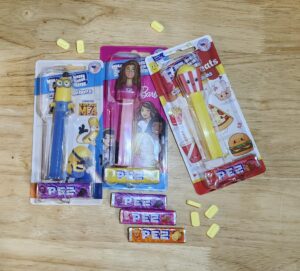
For over a century, PEZ dispensers have come in all shapes and colours. Cartoon heads were added in the 1930s as a marketing device, and each collectible dispenser is ready to pop out delicious candy tablets. Photo (C) Susanna McLeod.
Established by his grandfather and father in 1894, “Eduard Haas III (1897-1989) took over management of the company when he turned 18, and created its first newspaper advertisements for their pre-measured cake mix,” said Theresa Machemer in Smithsonian Magazine, December 15, 2020. An early advocate for non-smoking, young Haas expanded the business into confections, starting with a breath-freshening candy that would help cut down on smoking yet not add to overindulging.
The inspiring idea required research. Peppermint oil was expensive. The ingredient was usually boiled in manufacturing where the extract dissipated and lost its tasty punch. “Haas Company chemists developed a tablet manufacturing process that’s cold,” said Machemer, retaining the zesty flavour. Blending the processed peppermint with confectionary ingredients in about 1927, the first candies were compressed into round tablets. The tablets were packaged in foil wrappers and small metal tins.
Haas decided that the new product deserved a catchy name. He wanted something related to the flavour. Taking the first, middle and last letters of the German word pfefferminz, he devised the short and memorable name, PEZ. The initial candies called PEZ Drops were advertised for the adult market with anti-smoking in mind.
The peppermint-fresh confections were so popular that Haas’ factory changed production runs from baking powder and other cooking ingredients to candies. “Mechanized tablet-forming processes pushed PEZ to change course in the 1930s, from round tablets to their now-familiar rectangular ones,” noted Machemer. More than a decade later, an attention-grabbing advancement was introduced.
After World War Two, the smoking habit increased in the population. The health-oriented Haas again focussed on anti-smoking and also thought a more hygienic container would be better than wrappers or small tins. The container would be easier to grab a single tablet with one hand or share, without other fingers touching the candies. Haas hired an engineer to create designs, and Oskar Uxa developed a slender container that fit his client’s ideals. The first PEZ dispenser debuted at the 1949 Vienna Trade Fair.
The company filed a patent application in the United States on October 14, 1949 under the Pocket Article Dispensing Container section. The filing stated. “The invention relates to pocket containers having a hinged lid and adapted for the delivery of articles, such for example as pastilles, tablets, sweetmeats and cigarettes, which containers can be opened or closed with one hand, and present the merchandise to the user in a hygienic and unspoilt condition.” The container was slim, similar to the size of a lighter, and held a stack of tablets. There was no quirky face on top yet. Three years later on December 2, 1952, Patent # US2620061A was awarded to inventor Oskar Uxa of Vienna, Austria and Assignor to Eduard Haas of Muhlbach-Attersee, Austria.
Facilitating injection molding with plastic that was similar to casting with metal. The manufacturer used hot material and pushed it into a mold, described Machemer. “That allows you to make it much thinner and have a lot more detail.” The early dispensers were used as small marketing billboards. Other companies attached their own labels and gave out PEZ dispensers like business cards.
Increasing sales prompted Haas to develop markets in a different sector. The original customer base was adult-oriented and the company “had been using adult themes and sexy ‘Pez girls’ in their advertising,” said Inventor of the Week: Archive by the Lemelson-MIT Program in July 2005. Widely advertised in magazines, newspapers, appearing on trucks, uniform patches, and by representatives at movie theatres and events, PEZ dispensers were given out to entice customers to try the peppermint candy. The firm now eyed for the massive kids’ market.
Developing advertising strategies, Haas introduced PEZ to the toy market. The businessman ordered cartoon heads to be affixed to the top of the PEZ dispenser. He also presented “new fruit flavors designed for kids—lemon, orange, strawberry and later, grape.” The early topper heads were familiar fun faces, featuring “Santa Claus, Popeye, and a space trooper,” according to Inventor of the Week: Archive. The new sector was an instant success.
Running with the exciting scheme, PEZ marketers licenced famous characters for the dispenser tops. Soon, candy was popping out of dispensers with “Bozo the Clown, Casper the Friendly Ghost, and Mickey Mouse.” A continuous stream of colourful heads gave the candy company a vivid role popular culture. By this time, Haas Food Manufacturing Corp. was prosperous, and PEZ founder Eduard Haas III was wealthy.
“It became clear that the company needed to manufacture its products in the United States rather than imported from Europe,” wrote Nina Chertoff and Susan Kahn in Celebrating PEZ (Sterling Publishing, Toronto 2006). “By the 1970s, PEZ began to be manufactured in a plant in Orange, Connecticut.”
Today, production and sales for the USA and Canada are distributed from PEZ Candy Inc. in Connecticut. PEZ International Gmbh in Austria produces and markets the delicious products for the rest of the world. According to the company, “PEZ products are available in more than 80 countries world wide.” Between Austrian and American production, “the two locations distribute approx. 70 million dispensers and 5 billion candies per year.”
The popular PEZ dispensers have become valuable collectibles. PEZ collector groups, Collectors Store, and pricing guides have emerged, plus a range of YouTube videos. On October 13, 1986, PEZ founder Eduard Haas III died at Vienna, Austria. His invention has delighted kids and adults, and maybe you, too, if you’re nibbling on another PEZ candy.
(C) Susanna McLeod 2026. This article first appeared in the Kingston Whig-Standard in February 2025.