
Hélène Boullé, an Urban Woman in the New World, 1620s
Hélène Boullé came to New France in 1620. Dissatisfied as a settler, she stayed only four years in Canada. Returning to France, she founded an Ursuline Convent.
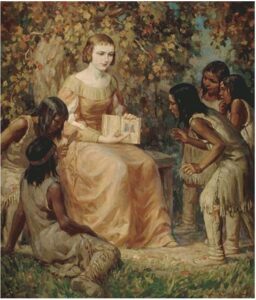
In the New World, Hélène Boullé taught Indigenous children. Painting, Adam Sheriff Scott, January 1931. Library and Archives Canada, 1991-36-1.
A bride at the tender age of 12, Hélène Boullé was given in marriage to Samuel de Champlain, one of France’s great world explorers, and early settler of Canada. The wedding took place in Paris on December 30, 1610. Hélène was so young that her father insisted she remain in the family home for two years after the wedding. The groom Champlain was a much older, worldly man at age 43. Hélène’s father Nicolas Boullé, was a secretary to the King’s Chamber, said Charles P. Otis and Edmund F. Stafter in their book, Voyages of Samuel de Champlain (John Wilson and Son, Boston 1880).
Hélène Boullé in New France in 1620
Studying her husband’s religion for two years, Hélène became Catholic when she was 14 years old. She brought a sizeable dowry of 6,000 livres to the union, according to the Lake Champlain Basin Project in Vermont, and the money was used by Champlain toward his trading post at Quebec City (at that time known as the native village of Stadacona). Ten years after the wedding and still only 22 years old, Hélène accompanied her husband on a trip to New France. She grew to care as deeply about the natives as her husband did, and the First Nations people also loved Hélène Boullé.
Samuel de Champlain was constantly occupied with his explorations and settlements, cultivating friendships and trust between the French and the natives. “Would God that all the French who were to the first to come into these regions,” later wrote Pere Lalemant in 1640, “had been like him,” according to Reverend Ed Hird in “Samuel and Hélène de Champlain: a 400-Year-Old Canadian Couple,” in the December 2003 issue of Deep Cove Crier. Hird noted that, “Champlain was the most versatile of Canadian pioneers, at once sailor and soldier, writer and entrepreneur, artist and voyageur, visionary and pragmatist.” The settler life was difficult and risky though, with bone-chilling winters, risk of starvation and vicious, bloody battles.
An Urban Woman as Pioneer
With her husband, Champlain, away most of the time, Hélène was unhappy with her lonely life in Canada. She was an urban woman of high spirits, used to shopping and chatter, perhaps vibrant music and the arts. Fancy clothes and a refined life were more in Hélène’s interests. There was little of that luxury to be had in New France. Hélène made friends with her fellow colonists and with the natives, but it was not enough to keep her on North American soil. After four years, she boarded a ship and left her husband in New France. She did not return. There is no record of any children born to Hélène and Champlain.
Samuel de Champlain died suddenly of a stroke at age 68 on December 25, 1635. His will left his property to Notre-Dame-de-la-Recouverance rather than his wife. Hélène gave up her rights under the marriage contract, said Marie-Emanuel Chabot in the Dictionary of Canadian Biography entry for “Hélène Boullé.” Marie Cameret, Champlain’s cousin, took on the affairs. She had the will squashed and became his only heir.
Hélène Boullé Joined Ursuline Convent
Ten years after her husband’s death, Hélène became a nun in the convent of Sainte-Ursule in Paris. She was 47 years of age when she took the name of Sister Hélène de Sainte-Augustin in 1645. She was unaccustomed to living under the controlled conditions required of a nun and found it restrictive. Not daunted, Hélène left that convent; she founded another Ursuline order in Meaux, a small city, using 20,000 livres of her own funds and some of her own furnishings, said Otis and Stafter.
As she was the founder, Sister Hélène was granted special privileges, added Otis and Stafter, “such as a superior quality of food for herself, exemption from attendance upon some of the longer services… and the letters of her brother, the Father Eustache Boullé, were to be exempted from the usual inspection.”
Champlain Named Isle St. Hélène
Hélène Boullé died at her Meaux convent on December 20, 1654 after a short illness lasting only a week. In Canada, an affectionate gesture by Samuel de Champlain in 1611 left a lasting reminder of Hélène. The explorer named an island after his beloved wife, the Isle St. Hélène. The island is now part of the city of Montreal, Quebec, situated in the St. Lawrence River. It is used as parkland.
This article first appeared on Suit101.com, July 2010. (C) Susanna McLeod